Poor Man's Burnt Ends Chuck Roast Recipe with Bbq Sauce
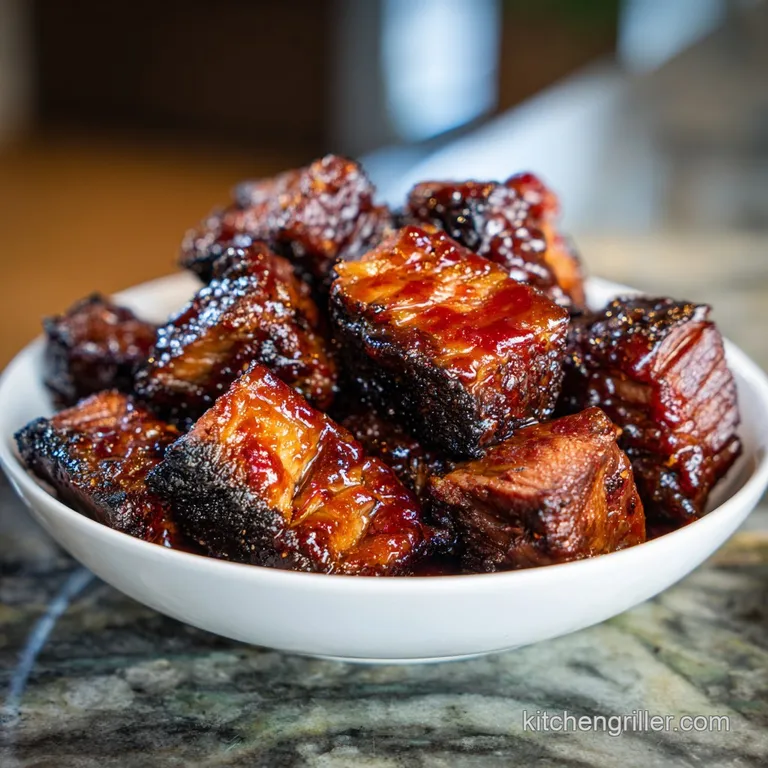
- Time: Active 20 minutes, Passive 5 hours 40 mins, Total 6 hours
- Flavor/Texture Hook: Velvety rendered fat with a tacky, caramelized bark
- Perfect for: Backyard BBQ enthusiasts seeking brisket style results without the high cost
- Laboratory Secrets of Meat Texture Science
- Essential Components for Beef Success
- Necessary Tools for Precision Cooking
- Executing the Low and Slow Method
- Fixing Common Beef Texture Issues
- Creative Flavor and Diet Adaptations
- Managing Leftovers and Kitchen Waste
- Ideal Pairings for Smoked Beef
- Critical High in Sodium
- Recipe FAQs
- 📝 Recipe Card
The aroma hitting you as you open the lid of your cooker is something I can only describe as a primal olfactory trigger. It is the heavy, sweet scent of rendered beef tallow mingling with charred wood and the sharp tang of vinegar.
I remember the first time I attempted this; I was trying to replicate a high end brisket point but my bank account was screaming "chuck roast." I stood there, watching the smoke curl, wondering if a $20 cut of meat could truly transform into something legendary.
It’s a patience game, honestly. You aren't just cooking meat; you are conducting a thermal experiment. The chuck roast is a fascinating specimen because it’s packed with intramuscular fat and a dense network of collagen.
When you hit that sweet spot where the fibers finally surrender and turn into gelatin, you’ve achieved something special. If you rush it, you’re eating shoe leather. If you treat it with scientific precision, you get beef candy.
I’ve spent years in my backyard laboratory let’s call it a patio refining the temperature curves for this dish. Most people fail because they pull the meat too early or don't manage the humidity during the braising phase. We are looking for that specific moment of structural collapse.
Trust me on this: once you see the way the bark shatters under your teeth to reveal a velvety center, you’ll never look at a "cheap" roast the same way again.
Laboratory Secrets of Meat Texture Science
Collagen Hydrolysis: The long chain proteins in connective tissue only begin to break down into gelatin at temperatures above 71°C in a moist environment. By cubing the meat early, we increase the surface area exposed to heat, accelerating this chemical transition.
The Maillard Reaction: This is the chemical dance between amino acids and reducing sugars that creates the dark, flavorful crust known as "bark." Using granulated monk fruit in the rub provides a low glycemic substrate for this caramelization without burning as quickly as sucrose.
Hygroscopic Equilibrium: Salt acts as a denaturant, drawing moisture out initially but eventually dissolving proteins to allow the beef to reabsorb seasoned liquid during the braise. This ensures the center of each cube stays hydrated despite the long cook time.
Precision Checkpoints for Success
| Thickness | Internal Temp | Rest Time | Visual Cue |
|---|---|---|---|
| 2.5 cm cubes | 74°C (Initial) | No rest yet | Bark is set and doesn't rub off |
| 2.5 cm cubes | 96°C (Final) | 20 minutes | Cubes jiggle like jelly when shaken |
| 2.5 cm cubes | 63°C (Serving) | N/A | Sauce is tacky and clings to meat |
This table represents the critical path for your beef. Unlike a Smoked Brisket for recipe, where you have a massive thermal mass to manage, these smaller cubes respond much faster to temperature fluctuations. You have to be the guardian of the thermometer here.
Essential Components for Beef Success
The selection of your meat is the foundation of this entire experiment. You want a chuck roast that looks like a marble floor streaks of white fat running through the deep red muscle. That fat is your insurance policy. Without it, the "burnt ends" will simply dry out and become fibrous.
I always look for a "Prime" or high end "Choice" grade if available, as the fat content in the serratus ventralis muscle (the main part of the chuck) is what creates that velvety mouthfeel.
In my lab, I’ve found that the rub is just as technical as the heat. We are using coarse black pepper because the larger grains create "nooks and crannies" for smoke to latch onto, resulting in a superior bark.
The addition of avocado oil is strategic; it has a high smoke point (271°C), which means it won't break down or create off flavors during the long residency in the cooker.
Component Analysis
| Ingredient | Science Role | Pro Secret |
|---|---|---|
| 3.5 lbs Beef Chuck | Protein Source | Choose "well marbled" to ensure internal lubrication. |
| 1.5 tbsp Kosher Salt | Protein Denaturant | Use coarse salt to control the rate of moisture extraction. |
| 0.5 cup Bone Broth | Braising Medium | Provides extra collagen to enhance the "sticky" mouthfeel. |
| 2 tbsp Apple Cider Vinegar | pH Adjuster | Softens the muscle fibers while cutting through heavy fat. |
Necessary Tools for Precision Cooking
You cannot eyeball this recipe. Precision is the difference between a pitmaster and someone just making lunch. You'll need a reliable internal thermometer to track the "stall" that period where evaporative cooling matches the heat input, and the temperature stops rising.
This usually happens around 65-74°C. Don't panic when it happens; it's just physics.
You also need a heavy duty foil pan. A thin, flimsy pan will allow the bottom of your cubes to scorch when we add the BBQ sauce and butter. I prefer a cast iron Dutch oven or a thick aluminum catering tray. The goal is even heat distribution during the "tack" phase.
Chef's Tip: Freeze your grass fed butter for 10 minutes before cubing it. This prevents it from melting instantly when you toss it with the hot meat, allowing it to coat the beef more evenly as you seal the pan.
- Sharp Chef's Knife: Essential for clean, 2.5 cm cubes without tearing the grain.
- Digital Meat Thermometer: Must be instant read to avoid heat loss during checks.
- Spray Bottle: Fill with 1 part ACV and 1 part water for spritzing.
- Disposable Gloves: Makes the rub application and saucing much cleaner.
Executing the Low and Slow Method
- Prep the beef. Slice your 3.5 lbs beef chuck roast into uniform 2.5 cm cubes. Note: Uniformity ensures every piece finishes at the exact same moment.
- Apply the binder. Coat the cubes in 2 tbsp avocado oil. until every surface has a slight sheen.
- Season the cubes. Combine pepper, salt, paprika, garlic, onion, and monk fruit. Toss with the meat until no bald spots remain on the beef.
- Initial Smoke. Place cubes on the rack at 120°C. until the exterior feels like sandpaper and the color is mahogany. This usually takes about 3 hours.
- Monitor the bark. Spritz with apple cider vinegar every 45 minutes after the first 1.5 hours. until the edges look slightly charred but not burnt.
- The Braise. Move cubes to a pan. Add 0.25 cup grass fed butter, 0.5 cup bone broth, and 2 tbsp ACV. Note: This mimics the 2 1 Ribs recipe technique to tenderize tough fibers.
- Seal and cook. Cover tightly with foil. Bake or smoke at 135°C until an internal probe slides in like a knife through soft butter. This is typically 1.5 to 2 hours.
- The Glaze. Drain half the liquid. Toss with 0.5 cup low sugar BBQ sauce. until every cube is glistening and velvety.
- The Final Tack. Return to heat uncovered for 20-30 minutes. until the sauce bubbles and becomes sticky enough to coat a spoon.
- Rest. Let the meat sit for 15 minutes. Note: This allows the juices to redistribute so they don't leak out upon the first bite.
Fixing Common Beef Texture Issues
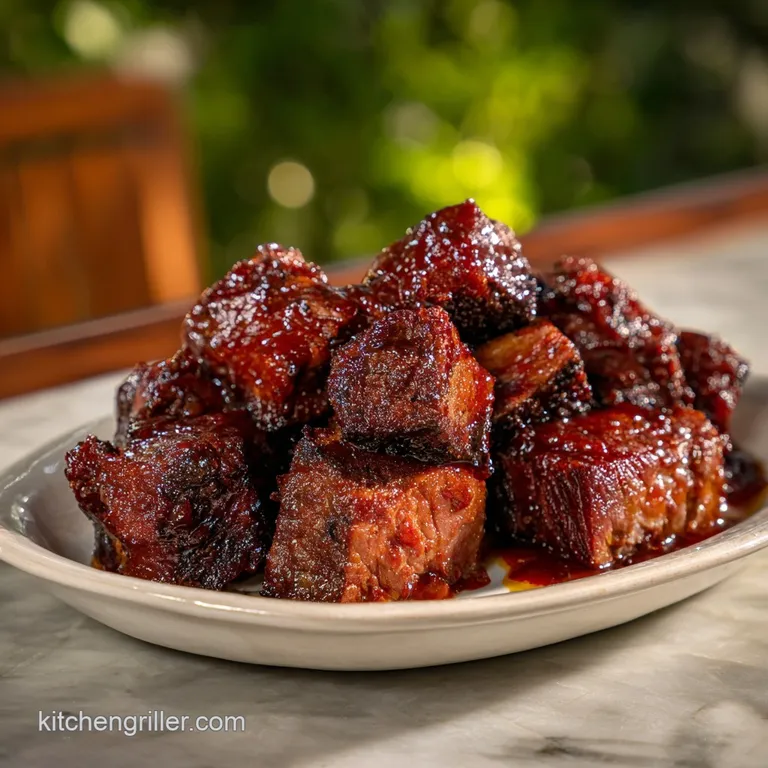
One mistake I once made was rushing the final braise because guests were arriving. The result? The meat was technically "cooked" but the collagen hadn't fully converted. It felt like chewing on rubber bands. To avoid this, always aim for temperature, not time. If your cubes feel tight or bouncy, they aren't done.
They should feel like they might fall apart if you squeeze them too hard.
Why Your Beef Feels Tough
It's almost always a matter of temperature or moisture. If the environment is too dry, the exterior of the meat hardens before the interior can break down. This is called "case hardening." By using the pan and broth method, we create a high humidity micro environment that forces that collagen to melt.
| Problem | Root Cause | Solution |
|---|---|---|
| Meat is dry/fibrous | Pulled too early or too little fat | Cook until 96°C; ensure "well marbled" start |
| Bark is mushy | Too much liquid in the pan | Reduce liquid or leave uncovered for final tack |
| Overly salty | Using table salt vs kosher | Use Kosher salt; it has larger grains and less "saltiness" per tbsp |
Common Mistakes Checklist
- ✓ Never crowd the cubes on the rack; they need airflow to develop bark.
- ✓ Preheat your cooker for at least 30 minutes to stabilize the thermal mass.
- ✓ Don't skip the ACV spritz; the acidity is a chemical tenderizer for the surface.
- ✓ Always use a low sugar sauce to prevent the sugars from scorching at high heat.
- ✓ Let the meat rest; a 15 minute rest prevents "moisture purge" on the plate.
Creative Flavor and Diet Adaptations
Scaling this recipe is straightforward, but remember the "surface area" rule. If you double the meat, you don't necessarily double the rub. You need just enough to cover the surfaces. For a 7 lb roast, I usually only go to 1.5x the salt and spices to avoid a sodium bomb.
If you are looking for a different profile, consider a spicy kick. Add 1 tsp of chipotle powder to the rub. The smoke from the chipotle complements the beef's natural richness beautifully. For a Keto version, the monk fruit and low sugar BBQ sauce already have you covered.
Cooking Method Comparison
| Method | Time | Texture | Best For |
|---|---|---|---|
| Oven | 5 hours | Consistently tender, less bark | Winter cooking / No smoker |
| Pellet Smoker | 6 hours | Superior bark, deep smoke ring | Authentic BBQ flavor |
| Stovetop/Dutch Oven | 4 hours | More like a stew, no "shatter" bark | Quickest results, zero smoke |
Managing Leftovers and Kitchen Waste
Storing these burnt ends is easy because the high fat and gelatin content keeps them from drying out in the fridge. They stay fresh for up to 4 days in an airtight container. When reheating, avoid the microwave it turns the fat rubbery. Instead, use a pan over low heat with a splash of bone broth.
For zero waste, don't toss that leftover braising liquid! It is essentially liquid gold. I strain it and use it as a base for a "cowboy" chili or a rich beef gravy. The rendered fat (tallow) can also be skimmed off and used to sear steaks later in the week.
Freezing: You can freeze these for up to 3 months. I recommend vacuum sealing them with a little bit of the extra sauce to prevent freezer burn. To reheat, just drop the sealed bag into simmering water until warmed through.
Ideal Pairings for Smoked Beef
Because this dish is so rich and unctuous, you need side dishes that provide contrast. Something acidic or crunchy works best to "reset" your palate between bites. A sharp apple slaw or pickled red onions are my go to choices.
If you're doing a full BBQ spread, these go perfectly with a 2 1 Ribs recipe or even some Smoked Pork Butt recipe. The common theme is the low and slow patience. For a starch, try a smoked mac and cheese the creaminess handles the salt and smoke of the burnt ends like a dream.
Myth: Searing First Seals Juices
This is a classic kitchen tale. Searing meat does not "seal in juices." In fact, the high heat of a sear causes muscle fibers to contract and squeeze out moisture. We apply the rub and go straight to low heat to allow the meat to relax and the seasoning to penetrate deeply through osmosis.
The "bark" we create isn't a seal; it's a flavorful crust created by the Maillard reaction.
Myth: You Can't Get Burnt Ends Without a Smoker
While a smoker adds that distinctive wood flavor, the "burnt end" texture is actually a result of the fat and collagen breakdown and the caramelization of the sauce. You can achieve 90% of the result in a standard oven by using a touch of liquid smoke in your braising liquid and focusing on the temperature checkpoints.
Success is about thermodynamics, not just wood smoke.
Critical High in Sodium
1140 mg 1140 mg of sodium per serving (50% 50% of daily value)
American Heart Association recommends a limit of about 2,300mg of sodium per day.
Tips to Reduce Sodium in Your Roast
-
Low-Sodium Broth-30%
Replace the beef bone broth with unsalted or very low-sodium beef broth. This can significantly cut down the sodium content.
-
Reduce Salt-25%
Decrease the amount of kosher salt used from 1.5 tbsp to 0.75 tbsp. Taste and adjust after cooking, if needed.
-
Low-Sodium BBQ Sauce-20%
Opt for a low-sodium or sodium free BBQ sauce. Many brands offer lower sodium versions without sacrificing flavor.
-
Spice It Up
Enhance the flavor with more herbs and spices like smoked paprika, garlic powder, and onion powder instead of relying heavily on salt for seasoning. Consider adding a pinch of cayenne pepper for some heat.
Recipe FAQs
Can you use a chuck roast for burnt ends?
Yes, chuck roast is ideal for "poor man's" burnt ends. It contains the necessary intramuscular fat and connective tissue (collagen) that breaks down into gelatin, providing the necessary moisture and texture.
Can you make burnt ends on a barbecue?
Yes, barbecues are the preferred cooking environment. Barbecues (smokers) allow for the low-and-slow temperature curve needed to render the fat and build the signature caramelized bark.
What is the best meat for poor man's burnt ends?
Beef chuck roast is the best budget option. Look for a well marbled roast, as the fat content is critical for maintaining moisture during the long cook time.
What is the secret to tender burnt ends?
The secret is long, slow cooking to achieve complete collagen hydrolysis. You must cook the cubed meat until an internal temperature of 96°C is reached, allowing connective tissue to convert fully to gelatin.
How do I ensure the cubes don't dry out during the initial smoking phase?
Spritz the cubes every 45 minutes with an acidic mixture like apple cider vinegar. This maintains surface moisture while the bark sets, preventing the exterior from hardening too quickly.
Is it true that I should not apply the BBQ sauce until the very end?
Yes, always sauce near the end of the cook. Applying sugary BBQ sauce too early will cause the sugars to scorch and turn bitter before the internal structure of the beef is fully tenderized.
What internal temperature signals the meat is ready for saucing and glazing?
Aim for 90°C to 93°C before introducing the sauce. At this point, the meat is tender, and the final 20 30 minutes uncovered allows the sauce to tack up without overcooking the beef.
Poor Man S Burnt Ends
Ingredients:
Instructions:
Nutrition Facts:
| Calories | 788 calories |
|---|---|
| Protein | 49.6 g |
| Fat | 61.8 g |
| Carbs | 5.2 g |
| Fiber | 0.8 g |
| Sugar | 2.9 g |
| Sodium | 1140 mg |
